
Case Study — Bali, Indonesia
Our First Commercial Circular Partnership
Finns, the world's best beach club: closed the loop with us.Proven, paid, and fully traceable.
The Collection
Got trashed at Finns.
The Story
One more round on Finns.
Every day, thousands of guests create memories at Finns. What they leave behind — towels, uniforms and linens — doesn't have to end there.
Finns handed over the textiles their operation could no longer use. Every kilogram was collected, sorted and documented for material purity before it left the property, then regenerated from waste into yarn and woven back into RE·CYRCLE™ fabric.
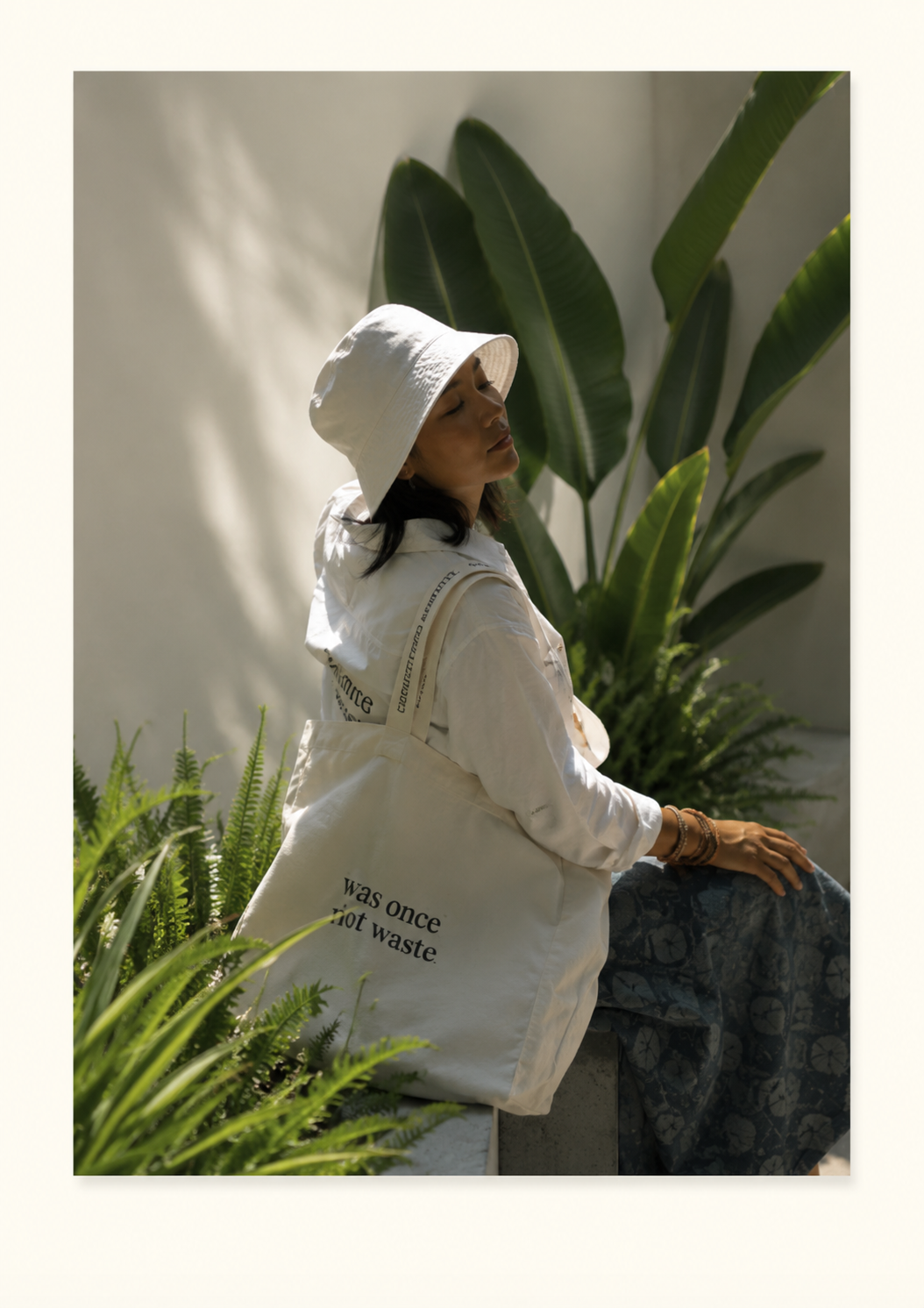
It comes back as a retail collection guests can take home — the same fibres, a second life, on the same beach. Because at Finns, one round should never be the last.
The Process
Four steps, fully documented.
- 01
Collect & Record
Discarded towels, linens and uniforms are weighed and tracked by batch before they leave the property.
- 02
Sort & Recover
Every batch is sorted, assessed and documented for material purity and non-landfill pathways.
- 03
Regenerate
Eligible textiles progress into recovered fibre, yarn and woven RE·CYRCLE™ fabric.
- 04
Return & Share
Remade into a retail collection sold back at the club, with QR traceability on every piece.
The Impact
What one beach club kept in circulation.
- Textile waste collected
2,434.3kg
Textile waste collected
- Recovery-eligible
99.2%
Recovery-eligible
- Water conserved
1.4million L
Water conserved
- Avoided incineration
1,954.8kg CO₂e
Avoided incineration
- Material substitution
1,120.1kg CO₂e
Material substitution
Recovery-eligible is measured from the 1,482.6 kg of textiles sorted and verified for waste composition and condition. Environmental outcomes are estimated using the RE·CYRCLE™ impact methodology.
Live Impact
The proof, updated in real time.
These panels read straight from the RE·CYRCLE™ platform. Nothing here is a mock-up — when Finns retires another batch, these numbers move.
What came in
What Finns put in motion.
Every kilogram entering the programme, from collection to what came back as product.
What it was made of
Not all textiles are the same.
Once sorted, every batch is classified by composition — and that decides where it can go next.
What kind of items
Towels, shirts, aprons, pants.
The same sorted material, split by garment. July is shown by default — the month the programme ran at full volume — but you can switch months on the chart.
Where it went
Where every kilogram ended up.
The full journey from collection to finished product, traced batch by batch.
What that was worth
The impact, broken down by material.
Landfill avoided, water saved and emissions cut — and how much of each came from cotton rather than mixed waste.
What It Became
Back on the beach, as product.
Recovered Finns textiles returned as five pieces guests can carry home — each one carrying its own share of the impact above.
Swipe the table sideways to see water and emissions.
Trace any piece.
Every product carries a code. Scan it, or open the story, to see the batch it came from and the impact it holds.